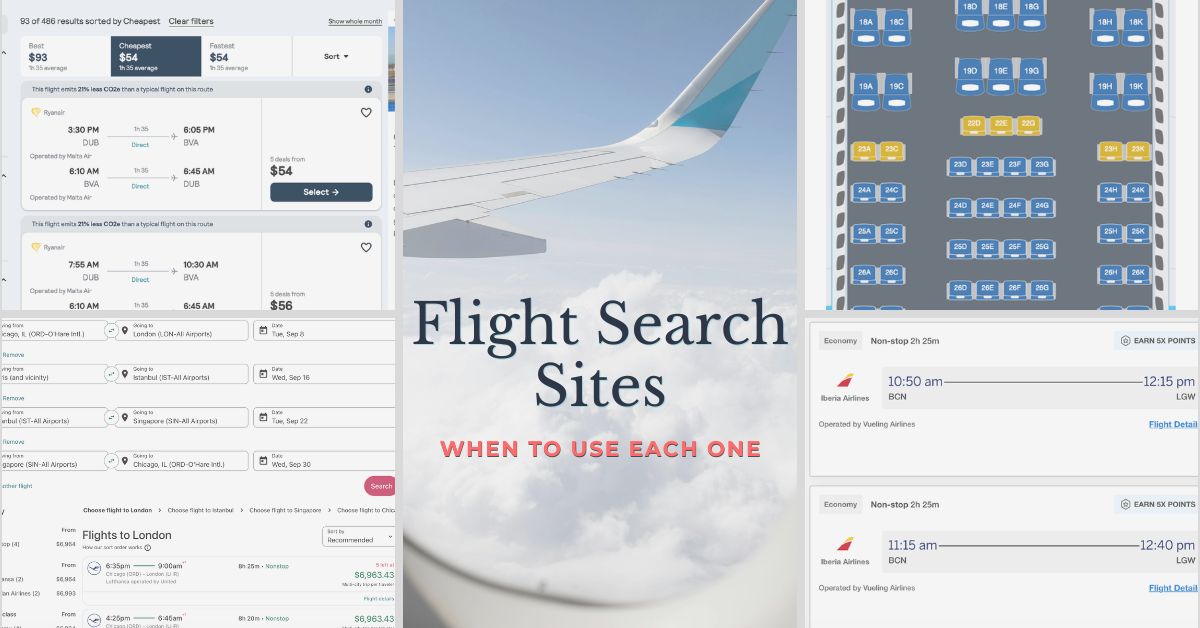
You’ve got five tabs open with different flight search sites, and all five disagree.
Skyscanner says $412, Google Flights says $392, Kayak says $404, the airline’s website wants $447, and your credit card portal shows something different too.
The roundups hand you fifteen sites and another twenty minutes of searching, which buys you more confusion, more fatigue, and no answer.
Your question is narrower: which site do I open for this trip? And underneath it, the real one. Did I book the right flight, at the right price, and will I be comfortable once I’m on it?
Cheap matters. Cheap on its own puts you beside the lavatory on a thirteen-hour flight, on a carrier where your status counts for nothing. The cheapest fare and the right fare are different things.
So here are the seven flight search sites I open before booking, what each does better than the rest, and the order I run them in. Plus the three I stopped checking.
What’s In This Guide
- The seven sites
- Before you book
- Putting it together
1. Your Airline’s Website (When Loyalty Beats the Fare)
Chasing status, holding a companion ticket, or sitting on an e-credit? Start here.
Most airline sites run a flexible dates calendar that shows a week of prices at once, so you spot the cheap days without running thirty searches. Members-only and site-only sales live here too, and they surface nowhere else.
The fare is only part of what you’re buying. Booking direct with the airline you fly most keeps you earning toward the upgrade, the lounge access, the free bag, and the drink before takeoff. Status compounds.
Third-party sites also sell restricted fares that earn no status points and can’t be changed. When a flight goes wrong on one of those tickets, the airline points at the agency and the agency points at the airline.
What you give up: you can’t compare carriers here. Without loyalty to protect, this isn’t your first tab, so move on.
2. Your Credit Card Portal (Search Everywhere Else First)
This one still makes me mad.
Christmas in Colombia, 85,000 Sapphire points sitting there, and the flights already found on Skyscanner: Orlando to Cartagena on Copa, around $400 per person.
In the Chase portal, those flights didn’t exist.
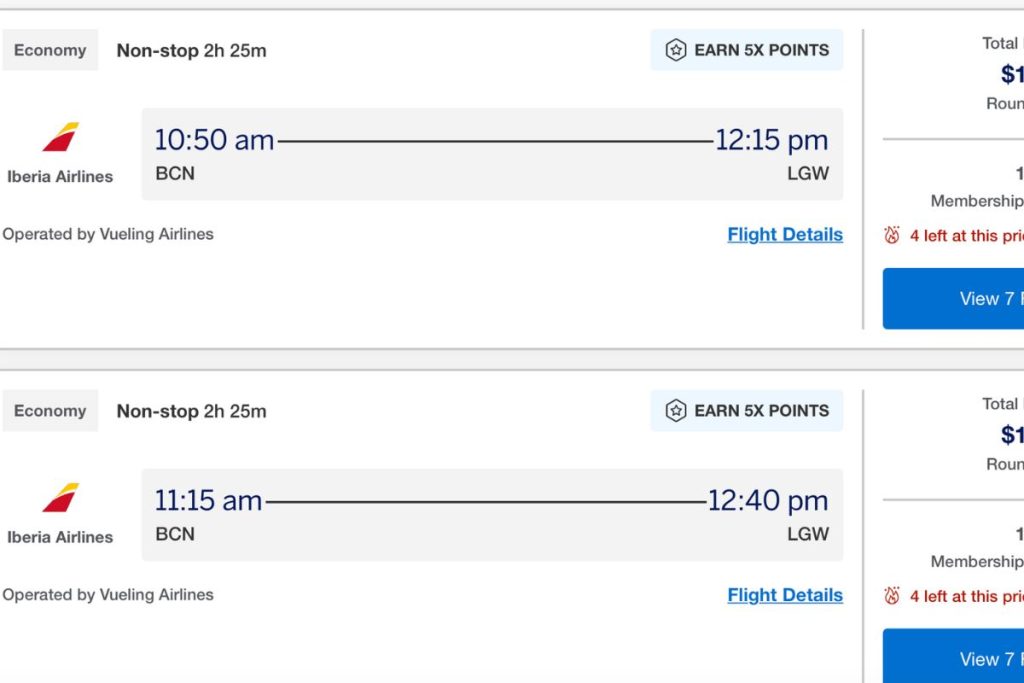
Not sold out, not pricier, gone, with no Copa out of Orlando at all and a rep explaining that Chase had no relationship with the airline. (Then why were the Miami Copa flights there?) A week later, out of stubbornness, the same route showed up at the same price. We booked with points and took $1,600 off the total cost of the flights.
Portals don’t carry the same inventory as public search sites. Availability shifts, flights vanish (and then return days later), and nobody explains why. The portal is inconsistent.
One more thing worth checking rather than assuming: portal coverage of budget carriers is inconsistent and moves without warning. Some portals carry easyJet and Vueling. Others carry neither. Ryanair has been absent from the major US card portals, though it now sells through Expedia, and card portals run on the same infrastructure. Run the search in your own portal before you decide your points are useless on that route.
I’m writing this from Asia, on a trip we booked through that same Sapphire portal, and this time the flight inventory was there during booking. Same account, opposite result. Also writing while using our Yesim eSIM. The internet has been touch-and-go in China, and even the hotels’ connections have been on the struggle bus. Pulling up a boarding pass, finding a hotel reservation at passport control when they ask where you’re staying, or hailing a car all need data the moment you land.
Search the aggregators first to learn what exists, then check whether your portal has it. If it doesn’t, call and ask, or wait a few days (if you have time on your side) and look again.
Before You Open a Single Tab
My free guide, Flying to Europe: The Complete Money-Saving Guide, covers the part no search site tells you: when to buy, what school holidays cost you, and how the points math works. Grab it below and keep it open while you search.
3. Kiwi.com (When You Don’t Know Where You Want to Go)
Kiwi is built for “somewhere interesting and cheap,” not “New York to Prague, specifically.”
Search your home airport to Anywhere and it maps where fares are low right now. Draw a radius around a region, say 500 miles of Paris, or line up several cities and compare them side by side. Put in Geneva, Paris, Barcelona, Milan, and Stockholm, see what’s cheapest, then build the trip around the fare instead of the other way around. Kiwi’s Anywhere search is the closest thing to browsing a map by price.
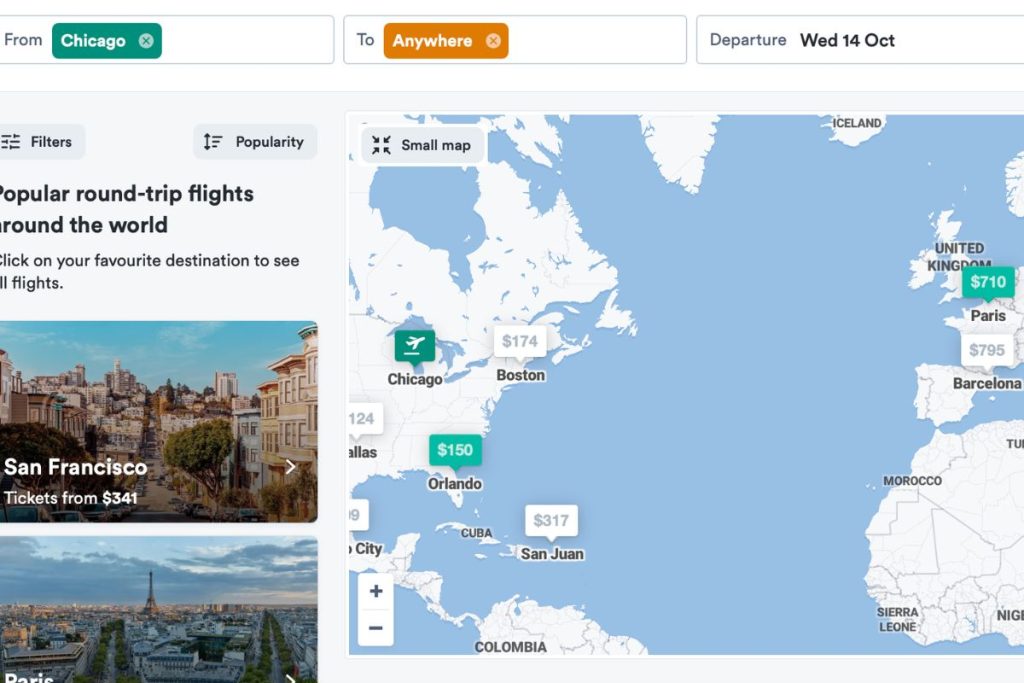
I lived in that search after we moved to France and €20 Ryanair fares became a normal Tuesday. Friends ask why we ended up somewhere random. That’s why.
The catch? Kiwi stitches together separate tickets on airlines with no agreement between them, sometimes with connections tight enough to make you sweat. Miss the second leg because the first ran late and the protection you’re relying on is Kiwi’s own guarantee, not the airline’s. Read what that covers before you book, or stick to direct flights when using Kiwi.
Flying from, to, or within Europe changes the math on that risk. EU261 entitles you to €250 to €600 per passenger for delays past three hours, cancellations, and denied boarding on covered flights, whether or not you booked direct. The 2026 overhaul of the regulation kept both that threshold and those amounts. Most people never claim it because the paperwork is miserable. AirHelp handles the claim and takes a cut of what lands, which beats the zero you collect by not filing.
4. Skyscanner (The Best All-Around Starting Point)
Skyscanner is where almost every one of my searches begins.
One-way, round-trip, multi-city, nearby airports, whole-country searches, all flexible without burying you in options. The filters hold up too: stops, departure and arrival windows, airlines, alliances, total duration. The monthly price calendar works (usually), and results reflect fares other people found last week, not theoretical numbers that evaporate at checkout.
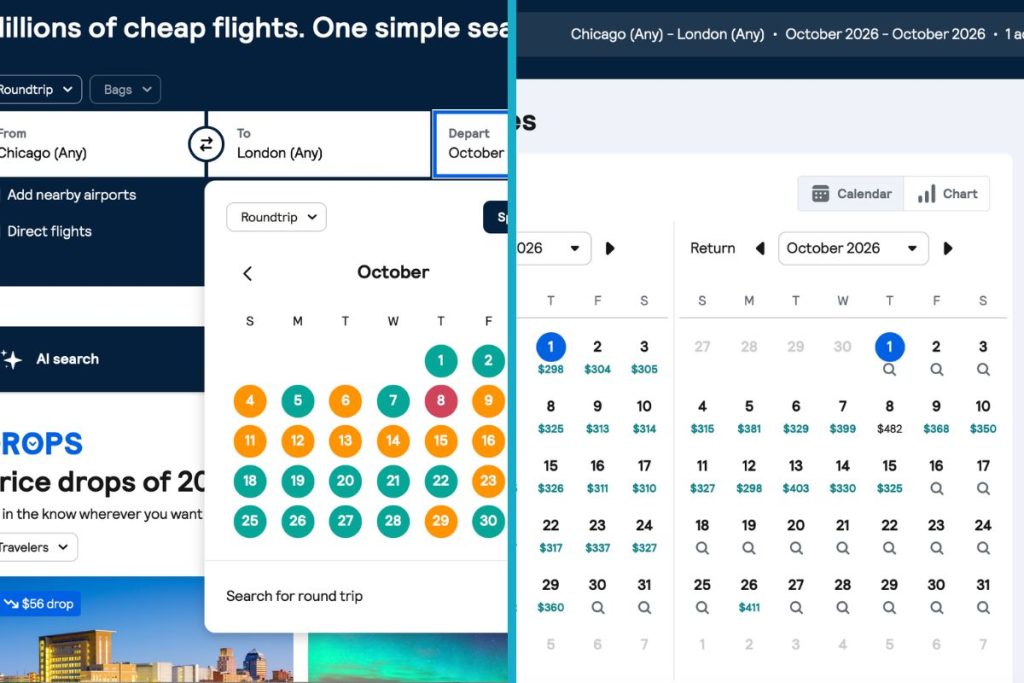
What it hides: the extras. You see the base fare and nothing else, so seat selection, checked bags, whether “cheap” means basic economy with no seat assignment and no meal, all of it waits until you click through to the airline. For a family of four, those extras add more than the fare difference you spent an hour hunting for.
The same 2026 EU overhaul will require fares to display with a cabin bag included, which changes the way a €24 fare looks on screen once it takes effect. Until then, treat the number as the opening of the conversation.
5. Google Flights (Best Visuals, Least Reliable Prices)
Google Flights has the best visual tools in the category. The map view prices whole regions at once when your dates are loose, the price graph tells you whether to book or wait, and price tracking emails you when a fare drops.
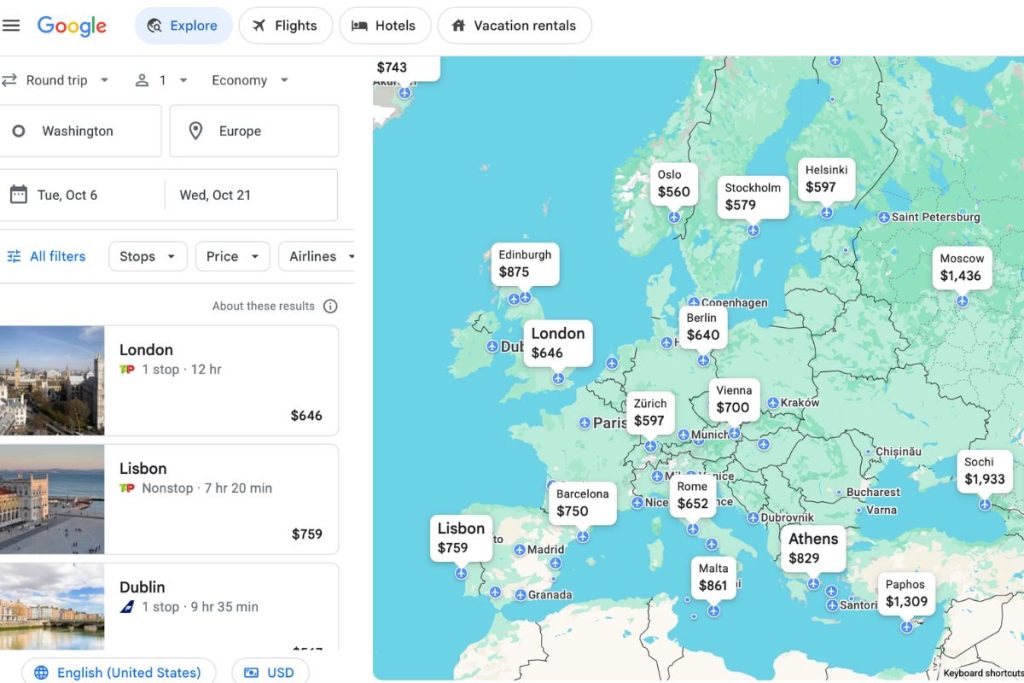
Then the click-through.
We had Delta e-credits to burn, and Stockholm to Tampa already loaded on the buy page. The husband checked Google Flights once more and found Barcelona to Orlando for about the same fare, which in February sounded excellent.
On Delta’s booking page the price jumped $187 per person. Google’s $543 became $730, which for four of us is $748 above what Google advertised.
Why keep it open? The planning tools earn their place when you’re flexible, as long as you believe the price only after the airline confirms it.
6. Orbitz (For Multi-City Routing Control)
Orbitz and Expedia sit under the same parent company and pull from the same inventory, so this isn’t a claim that one prices better than the other. They usually don’t. What Orbitz gives you is a different multi-city builder.
Lock your first leg at a specific time and price, and it shows what each additional leg adds to the running total. Segments become something you mix and match instead of one take-it-or-leave-it itinerary.
Beijing, Sydney, and Auckland in one itinerary, with an Auckland to San Francisco flight booked months ahead that fixed the timing on the last leg. Orbitz let me lock that leg, then work the others without restarting the search. Skyscanner may price individual flights lower. Orbitz gives you control over how they fit together, which is what you need when the timing has to work.
7. The Budget Carrier’s Own Site (Where the Real Total Lives)
Yes, this is the airline’s own site again, but site one is about protecting loyalty. This one is about a total that doesn’t exist anywhere else, and it’s the gap that costs Europe-based travelers the most money.
That gap used to be a listing problem. Ryanair spent two years signing distribution deals with the flight search sites it once locked out: Expedia, Kiwi, lastminute, Trip.com and TUI first, then Booking Holdings in August 2025, which put Ryanair fares onto Booking.com, KAYAK, Priceline and Agoda. Wizz signed its first aggregator deal with Travelfusion. The fare on your route is listed now. Search Skyscanner for a weekend in Porto and the €24 seat shows up.
The price is a different question. Wizz charges an OTA system surcharge on agency bookings, says so in its own help centre, and won’t refund it if the booking came through an agency. Ancillaries run close to 45% of Wizz revenue, so the fare on screen keeps shrinking as a share of what you hand over. Bags, seat selection and priority all price differently once you’re standing in somebody else’s checkout.
Book through an OTA that isn’t on Ryanair’s approved list and you’ll still face customer verification before you fly. A form to fill in, at the worst possible moment, for a booking you thought was finished.
After the aggregator pass, I open the budget carriers that fly my route. Two minutes, and on short-haul European routes it’s where the real number lives.
Stationed in Europe with a four-day pass and a school-holiday window? This is the whole difference between a weekend in Porto and a weekend at home, and the rest of what makes those weekends work is in the guide to travel while stationed in Europe. What 52 Ryanair flights taught me covers which fees are worth paying and which ones make the €24 fare a lie.
Check the Seat Map Before You Book Anything
This is the step people skip, and it’s the one that decides whether you spend the flight resting or counting minutes.
Though if you’re flying a low-cost carrier like Ryanair, the seat map is moot: none of the seats recline. Exit rows buy legroom and usually cost extra, and a front-row seat gets you to passport control sooner. (You don’t need a seat map to know which rows are at the front.)
Two sites do this well. AeroLOPA draws cabins to scale, so you see actual legroom and where the windows sit relative to each row. SeatMaps runs closer to the old colour-coded format, with pitch and recline listed out and photos of the actual seat.
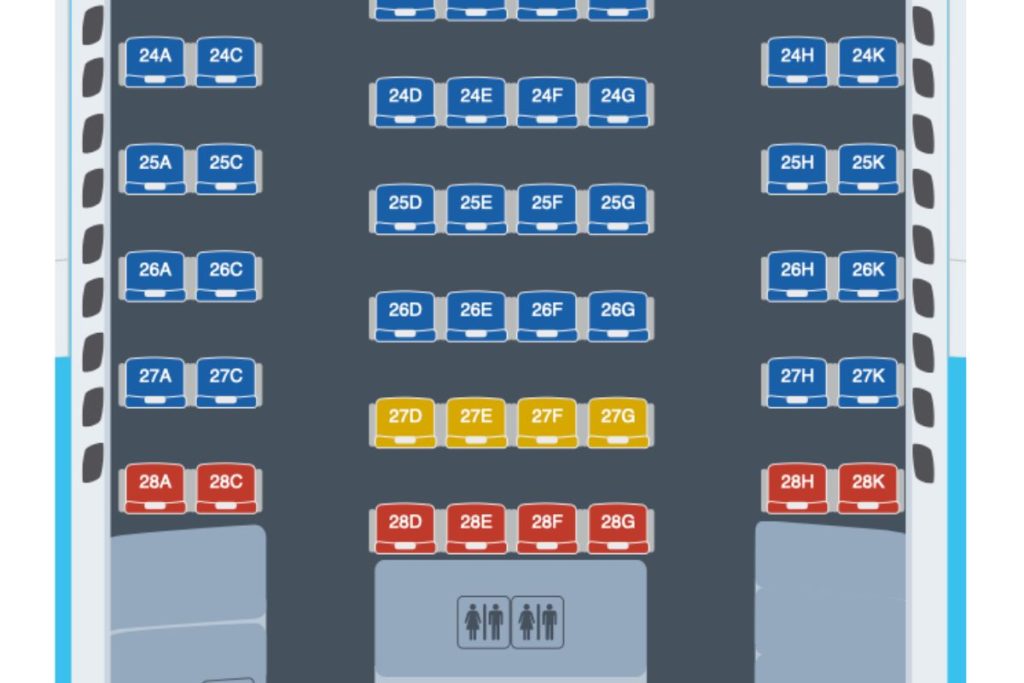
What you’re checking for:
- Window seats with no window. They exist on most aircraft and nothing warns you.
- Seats that don’t recline because they sit in front of an exit row or a bathroom. Survivable for two hours, brutal for five.
- The lavatory and galley rows. Traffic, light, and noise for thirteen hours straight.
- Misaligned seats where the seat and the window don’t line up, leaving you twisted the whole flight.
- Bulkhead rows, which buy legroom and cost you underseat storage.
Ninety seconds. Every time.
When the seat map comes back bad and the fare is still the right one, you pack around it. A proper sleep mask beats the airline giveaway (if they have one), a power bank saves you from a dead seat-back USB port, and volume-limited kids’ headphones keep the row next to you from hating you. The rest of what I bring is in 12 unexpected things I pack on every trip.
Searching When You’re Not Flying Solo
Always search for your total party.
Three things break when the passenger count goes up:
Seats together cost extra, and the fare never says so
That $792 headline assumes you’ll take whatever the algorithm assigns, which for four people booked late means four middle seats in four different rows. Fixing that costs per seat, per segment, and on a connecting round trip it stacks up faster than the fare difference that pulled you in.
The EU approved new passenger rules in July 2026 that will require airlines to seat children under 14 beside an accompanying adult at no charge, but the regulation still needs final publication and a one-year preparation period before it applies, and it covers EU flights only. Budget for the fee until it disappears.
Award availability shrinks as the passenger count rises
A route showing points space for one traveler often has nothing for four, and the price per person can shift with it. Search at your real passenger count from the first search.
Lap infants are never free
Taxes apply wherever you fly, and plenty of routes add a share of the adult fare on top. None of it appears in a search result until you’re deep in the booking flow, so find the number before you get attached to the flight.
If flying with small children is the part you’re dreading, the twins flying guide (still applicable for a single baby) covers the rest.
The Three Flight Search Sites I Stopped Checking
Kayak. Nothing here that Skyscanner does better, though it’s still my first stop for rental cars, alongside card portals.
Momondo. Same parent company as Kayak, same underlying results, different paint, so skip it.
Expedia. Good at bundling flights with hotels when a package beats two bookings, but for flight-only searching it adds nothing.
Your Actual Search Order: Which Flight Search Sites, and When
Where to start:
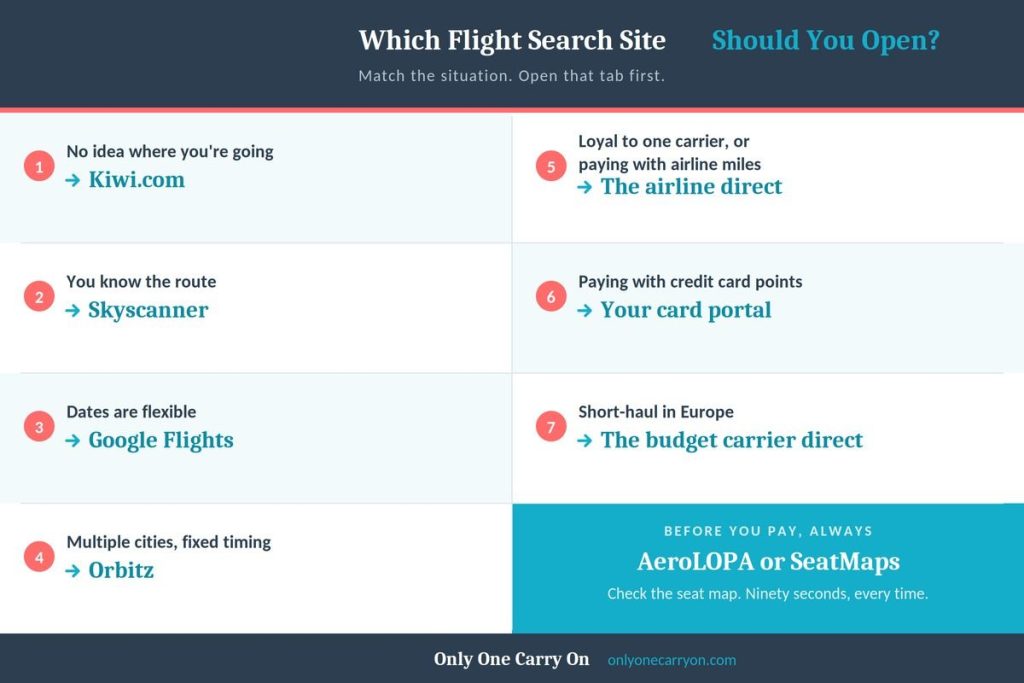
| Your situation | Open this | What it won’t tell you |
|---|---|---|
| No idea where you’re going | Kiwi.com | Whether the connection is protected |
| You know the route | Skyscanner | Bag, seat, and basic-economy fees |
| Dates are flexible | Google Flights | The real price at checkout |
| Multiple cities, fixed timing | Orbitz | The lowest single-leg fare |
| Loyal to one carrier, or paying with airline miles | The airline direct | What competitors charge |
| Paying with credit card points | Your card portal | Why inventory appears and vanishes |
| Short-haul in Europe | The budget carrier direct | Nothing. This is the real number. |
| Before you pay, always | AeroLOPA or SeatMaps | Nothing. Ninety seconds. |
The part nobody says out loud: the best deal isn’t always the cheapest flight. Sometimes it’s the one landing at a civilized hour without a soul-crushing layover in Charlotte or a 1am red-eye out of LAX.
Factor in your sanity, your schedule, the $80 in checked bags, and whether you’ll arrive able to function.
The Order I Book In
The table tells you where to start. This is the sequence for the five situations that come up most.
Flying on airline loyalty or airline miles
- The airline’s own site. Award space, status-qualifying fares, and member sales all live here first.
- A credit card portal that issues tickets on the airline’s own stock, so miles and status still credit. Amex Travel and Chase both do this on most carriers, and it’s worth confirming for yours before you pay.
- Skyscanner, for peace of mind that nothing better exists on another carrier.
- AeroLOPA or SeatMaps before you pick seats.
Paying with credit card points
- Skyscanner, to learn what routes and prices exist.
- Your card portal, to find out whether that inventory is there today.
- AeroLOPA or SeatMaps before you pick seats.
No idea where you’re going
- Kiwi’s Anywhere search, or Skyscanner’s Everywhere search, to shortlist by price.
- Skyscanner on the two or three routes that survived, for a real baseline.
- The airline direct, to confirm the fare and what the ticket includes.
- AeroLOPA or SeatMaps before you pick seats.
Multi-city
- Orbitz, to build the legs and lock whichever one has fixed timing.
- Skyscanner on each leg on its own, to see whether separate tickets beat the combined itinerary.
- The airline direct for any leg you want held under airline protection.
- AeroLOPA or SeatMaps before you pick seats.
Short-haul in Europe
- Skyscanner, for the landscape.
- Every low-cost carrier serving your airports, direct on their own sites. This is where the real number lives.
One more step for that last one. Cheap fares often route you into an airport nobody would choose on purpose: Beauvais instead of Paris, Girona instead of Barcelona, Hahn instead of Frankfurt. Price the ground transport before you call it a deal, because the fare wins and the drive takes the savings back. What 52 Ryanair flights taught me runs that math on real routes, fees included.
Five tabs, five prices, and only one of them belongs to the flight you’d book twice.
Flight search sites find you the options. Right route, right price, right seat: that part is still yours.
What to Book Right After the Flight
Price the car before you celebrate the fare. AutoEurope compares the European agencies in one search, which matters at secondary airports where two or three suppliers set their own rules.
For anything past three weeks, Car2Europe’s short-term lease beats a rental outright: brand-new car, insurance included, plus no extra driver, young-driver, or cross-border surcharges. Minimum 21 days.
Then work out whether the alternate airport still wins once you’ve added the car, the fuel, and ninety minutes each way. Sometimes it does. On a Girona run with four people and a car seat, it rarely does.
Save More on Flights to Europe
Flight search sites tell you what’s available. Flying to Europe: The Complete Money-Saving Guide tells you when to buy, what school holidays add to your fare, how budget carriers compare once fees land, and what your points are worth. Fifteen years of flight tracking, one guide, free.
Some links in this post are affiliate links, which means I may earn a small commission if you make a purchase through them, at no additional cost to you. I only recommend products and services I have used and believe will add value to your travels. Your support helps keep this blog running, thank you.