Stroller or No Stroller? What’s the Best Option for Flying With Twins?
September 15, 2026
Ok, it’s not exactly stroller or no stroller, unless you’re brave or have two adults per baby. It’s how many strollers, which stroller, when does it go on the plane, and how much of the airport you’re carrying a baby through instead of pushing one. Drop it at the counter, or bring it to the gate. Fly with the good one, or fly with something cheap. One stroller, or two. Double or single. Wear a baby through the whole airport, or only from the gate to your seat. Twins were never the easy option to begin with, but there is a right option for your trip.
Get the Twin Travel Survival Guide
Flying with twins for the first time? Get our complete packing checklist, airport survival strategies, and tested tips that actually work – free when you subscribe.
For everything else about flying with multiples, from security lines to nap schedules, see our complete Flying With Twins guide. Jump to whatever matches your trip, or read straight through for the full picture on the best stroller for flying with twins:
- One Stroller, One Free Hand
- Two Strollers, Twice the Ride
- Double Stroller, Double the Size
- Fancy Stroller
- No Stroller, No Break
- Counter-Check, Carry On
- One Parent, Two Babies
- Baby, Toddler, or Little Kid?
- Close Enough to Perfect
One Stroller, One Free Hand
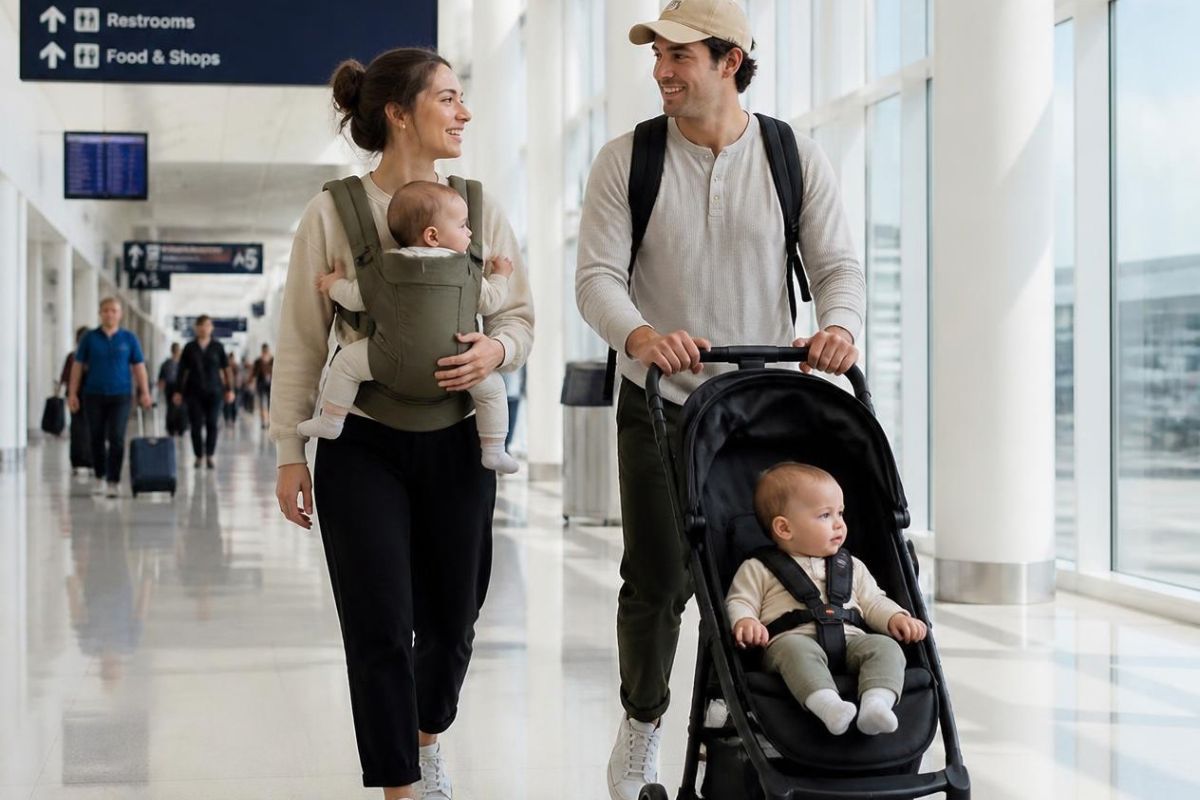
One stroller, two kids: one rides, one gets worn or walks. This is the lightest setup available, and it’s also the one where a stroller small enough for the overhead bin earns its keep. Friends of ours have flown with the gb Pockit and loved it, since it folds small enough to skip checking entirely, never gets gate-tagged, and never comes back damaged or delayed. It’s built for exactly one kid, which is the point here: the second twin rides in a carrier or walks, and the stroller only ever needs to hold one.
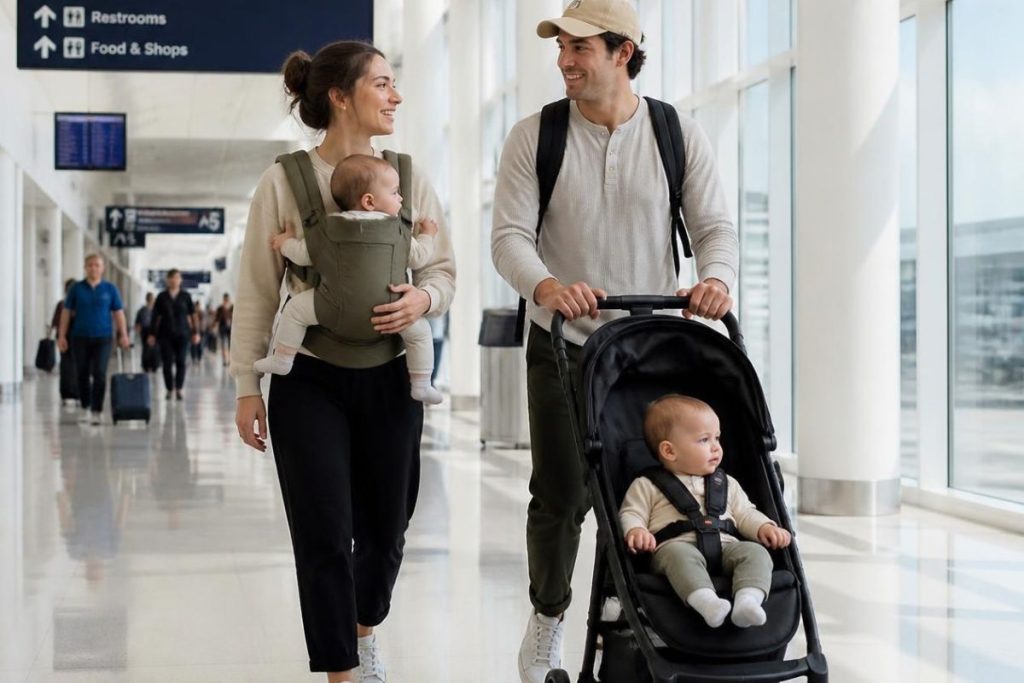
If you’re bringing a regular single stroller instead of something built for the overhead bin, the mechanics are the same as any other stroller: strip anything removable, learn the fold before you travel, and gate-check it if you want it with you until the door of the plane, or counter-check it at the ticket counter instead if you’d prefer not to manage it through security at all.
How it works, with two adults:
- With a baby: one adult wears the baby, the other pushes the stroller. At boarding, one adult holds both babies while the other folds it.
- With a toddler: the stronger walker can walk the whole way, or you can alternate who rides. If the free-roaming twin needs backup, one adult carries them.
- With little kids: both can walk, and whoever gets tired first takes the stroller.
- Nimble through a crowded terminal or onto an escalator (frowned upon or outright forbidden in most airports, but plenty of parents do it anyway at their own risk), since there’s only one stroller to manage.
The tradeoff: someone’s hands are always full. There’s no setting the second twin down into a stroller of their own.
Solo with one stroller: you’re wearing or walking one twin through the entire airport, no exceptions. More on that in One Parent, Two Babies below.
Two Strollers, Twice the Ride
Two single strollers means one per kid, and ideally, one per adult. We flew with two Kolcraft Cloud umbrella strollers for years (similar model here, since Kolcraft no longer sells the Cloud on Amazon: Dream On Me stroller). This is the way we always traveled, except for the time we forgot them in a hotel room, more on that below. They went to five continents and more countries than we bothered counting over three years, and the only real casualty was both cup holders: lost because we forgot to remove them before checking. Everything else survived, and we eventually donated them.
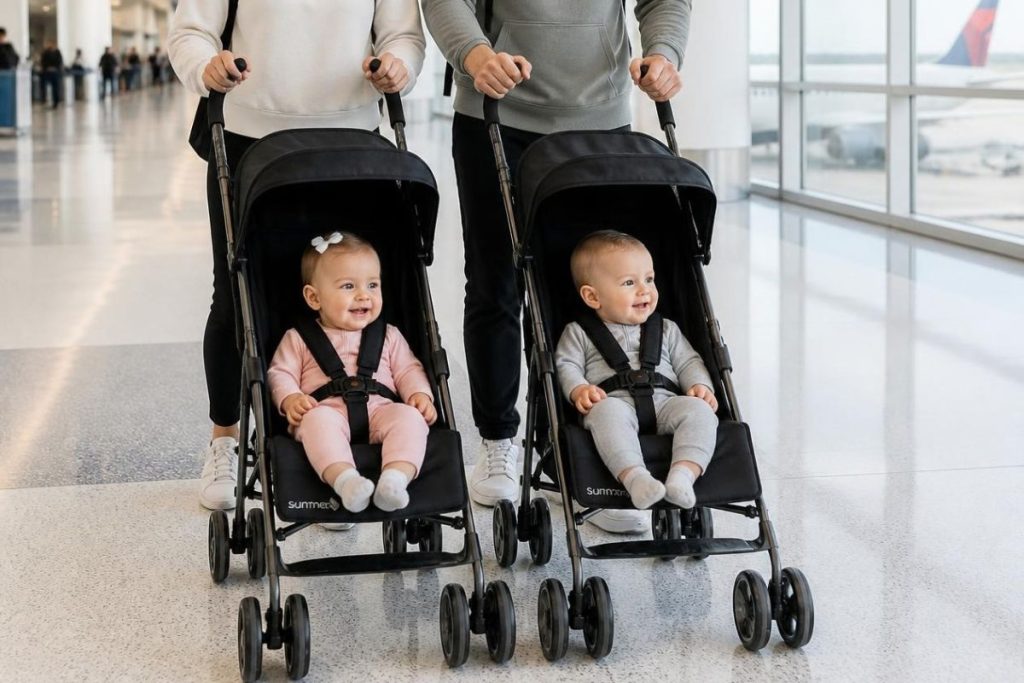
Gate-checking two strollers means twice the strip-down and twice the fold to remember, but each adult manages their own the whole way, which is more manageable with two adults splitting the work than it sounds.
How it works, with two adults:
- Each adult manages one stroller and one twin the whole way through the airport
- With a baby: at boarding, one adult holds both babies while the other folds both strollers
- With a toddler: each one can walk part of the way and ride when tired, so swapping who’s in a stroller keeps both adults moving at the same pace
- With little kids: two strollers in reserve means neither kid has to wait for the other one’s turn if their legs give out at different times
- In a pinch, one adult can push both strollers side by side alone, no connector needed. We’ve done this many times, and it works best on long, straight stretches without turns.
- We’ve never used a dedicated stroller connector ourselves, but they exist too. This one is a universal connector built to work across brands, though most others on the market pair with one specific stroller brand only, so check compatibility before counting on one.
Two strollers doesn’t mean two diaper bags. One bag can cover both kids, even on the rare flight where you and your twins end up thirty rows apart. We cover exactly how to make that work in 8 Items You MUST Pack When Flying With Twins.
If you need peace of mind, call the airport ahead of time and ask what happens at the jetway itself, not only what the airline’s general policy says. We’ve had gate agents wave us straight down the jetway with both babies still in their strollers, and we’ve had gate agents make us pull both kids out at the top of the jetway before we could board. Both were with the same airline, on different trips, at different airports. Even if you ask ahead of time, there’s no guarantee you’ll get the same answer once you’re at the airport. Take a deep breath. You had twins. You can do it.
Solo with two strollers: you’re managing both alone, which is possible but not easy. Worth reading One parent, Two Babies before you commit to this setup by yourself.
Double Stroller, Double the Size
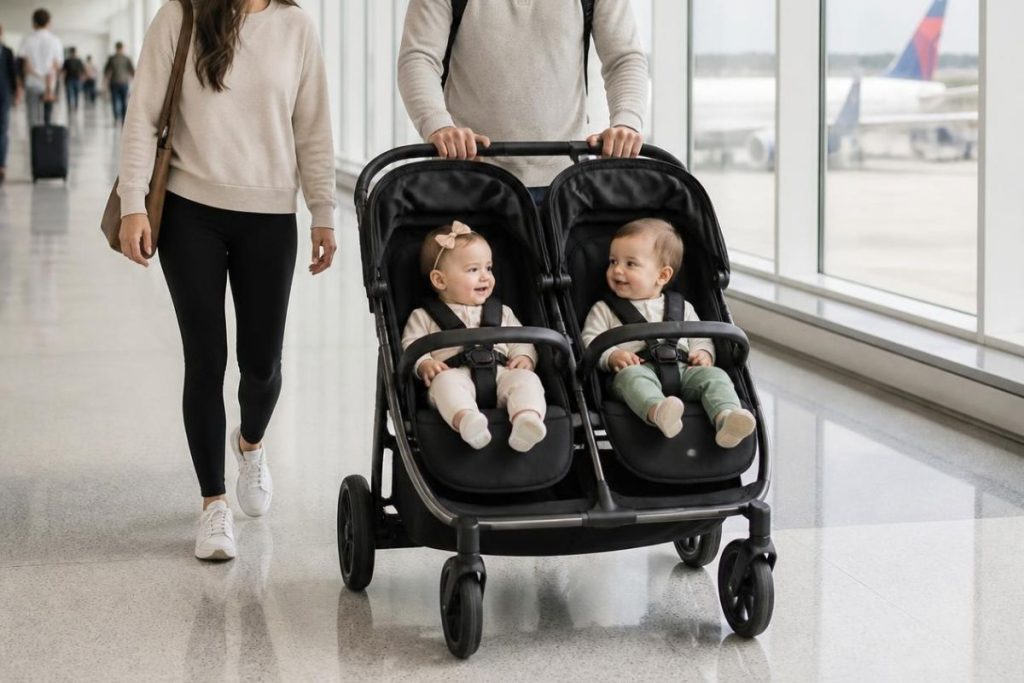
Yes, you can take a double stroller on a plane. Every major U.S. airline allows one, and in most cases it travels free, the same as a car seat, regardless of your checked-bag allowance. What changes is where you have to give it up: some airlines let you push it all the way to the door of the plane, and some make you check it at the ticket counter well before security.
One double unit means one set of wheels instead of two, which is easier to track, but it’s also wider, heavier, harder to angle through a jetway door, and impossible to fit in a narrow bathroom stall.
Airline policies on a stroller’s weight change more often than most parents expect. American Airlines, for instance, has capped gate-check weight at 20 pounds in the past, which rules out many double strollers before they even reach the gate. Confirm your airline’s current policy before you fly, instead of relying on what a blog post, including this one, says the rule used to be.
How it works, with two adults:
- One adult pushes the double stroller, the other’s hands stay free
- With a baby: at boarding, one adult holds both babies while the other folds it, or disassembles it into a transport bag
- With a toddler: keep one seat open for whichever twin is still working on listening, since a double gives you somewhere to strap a runner who isn’t listening
- With little kids: often more stroller than two kids who can mostly walk need, so this is the age where a double starts to feel like overkill
- Needs more room to maneuver than either single-stroller setup, and doesn’t fit on most escalators. Airports generally want strollers on an elevator instead.
Solo with a double stroller: one wide unit is often easier to manage alone than two separate strollers, since there’s only one thing to push and fold. See One Parent, Two Babies for the rest of the math.
Fancy Stroller
A Bugaboo Donkey Twin was the plush ride for our twins for years. It costs as much as a used car, frankly it cost almost three times as much as the car we drove our twins home from the birth center in (it was a junker), and it rides like you’re pushing a cloud. It has never once been on a plane.
The truth: it doesn’t matter whether the fancy one in your garage is a double, a single, or a jogging stroller. It’s built for pavement, not luggage carts and jet bridges. Airports treat every stroller the same, regardless of what it costs. Replacing a damaged cheap stroller, if it even needs replacing, costs less than replacing the fancy workhorse.
If the stroller you own is also the one your car seat snaps into, flying with it starts to make more sense despite the risk. Otherwise, the fancy one earns its keep at home, on sidewalks, not in a cargo hold.
No Stroller, No Break
Sometimes there’s no reason to bring one at all. Flying to see family who already have a spare stroller and car seat waiting? Don’t bring your own. That still means potentially carrying two babies through a long day of travel, so this works best with little kids or independent toddlers, not with babies. There’s nothing to risk, nothing to check, and nothing to fold.
Other times, it’s not the plan, but it works out anyway. On our first trip to Europe and Morocco with our newly two-year-old twins, we left both umbrella strollers in the closet of our Paris hotel room and didn’t realize it until we’d landed in Marrakech 🤦♀️. Fortunately, it was a welcome mistake. The medina’s alleys are as busy as a major city’s streets: mopeds, people, and cars go zipping through like little people don’t exist. We had five adults on that leg of the trip and split carrying the twins on our shoulders so they wouldn’t get bumped or hit. We picked the strollers back up on our way through Paris again after a stop in Portugal and used them for the rest of the trip, some days we used both, other days only one, depending on how much walking we had ahead of us.
How it works, with two adults:
- With a baby: each adult holds one, and one adult can hold both for a few minutes when needed
- With a toddler: let them walk when they can, each adult carries one as needed, and in a pinch one adult can carry both
- With little kids: let them walk, and carry them for short stretches when they’re tired. One adult per kid covers most of it.
How it works, with three or more adults:
- Splits the carrying enough that no one’s hands are full for long
- Nothing to fold, nothing to break, nothing left behind in a hotel closet by accident
Solo with no stroller: carrying or wearing both kids through the entire airport is the hardest version of this option, and rarely the right call without backup. One Parent, Two Babies below is written with exactly this in mind.
Counter-Check, Carry On
Sometimes you do bring a stroller, and still decide not to deal with it through the terminal. Counter-check whatever you brought at the ticket counter, well before security, and carry both kids the rest of the way through the airport. This is often the right call for a big stroller that’s over a gate-check weight limit, or more hassle to push through security than it’s worth.
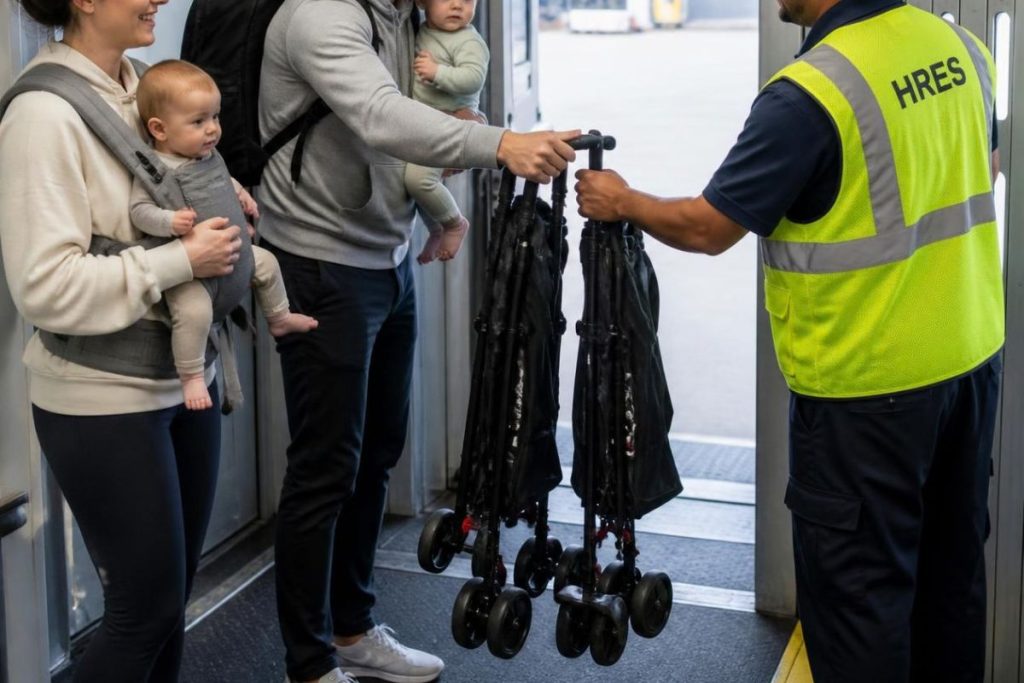
This works if your kids are strong walkers who can follow directions through security and the terminal, or if you and a partner can each wear one. It works less well when flying solo with two babies too young to walk, since carrying both through a security line and a boarding process is a real physical task, not a minor inconvenience.
The upside is real: no stroller to fold, no stroller to manage, since it’s already checked before any of that becomes your problem. That doesn’t mean it’s risk-free. A friend of ours counter-checked her stroller in the manufacturer’s own padded travel bag, and an agent still broke a piece re-packing it after a routine inspection. It wasn’t expensive to fix, and it wasn’t a critical part, but it was an inconvenience.
Solo and counter-checking: you’re carrying or wearing both kids through the entire airport the moment the stroller disappears at the counter. One Parent, Two Babies below is written with exactly this in mind.
One Parent, Two Babies
Two adults means splitting the work: one pushes a stroller, the other manages the bags, and if you’re running two single strollers instead of one, each adult can take a kid and a stroller of their own. Solo, that math falls apart. Counter-checking means carrying both kids through the rest of security, the walk to the gate, and boarding, with your hands and your back doing double duty. Gate-checking buys more help, since the stroller stays with you until the door of the plane, but you’re still the only adult managing it plus two babies or toddlers and your carry-ons.
When flying alone with twins, lean toward whichever setup keeps a stroller in your hands the longest: a single stroller with the second twin worn or walking, or a double that’s gate-check friendly, not the fanciest thing you own. Two separate strollers are the hardest configuration to manage completely alone, since you’re pushing, folding, and reassembling two of everything with no second set of hands.
Whatever you land on from the sections above, plan for the version of it that assumes no one’s coming to help carry a car seat down a jetway. That assumption alone will save more stress than any specific stroller choice.
Baby, Toddler, or Little Kid?
Every option above plays out differently depending on how old your twins are.
With babies, someone’s hands are full the entire time, no matter which setup you choose. A baby can’t be set down without watchful eyes, so a stroller isn’t optional gear, it’s the only place a baby can safely sit while your hands do something else. A hip seat carrier, like the Ergobaby Hipseat, takes some of the weight off while you carry them, and if you’ve got arms of steel, you can hand carry two car seats with the babies through the airport instead.
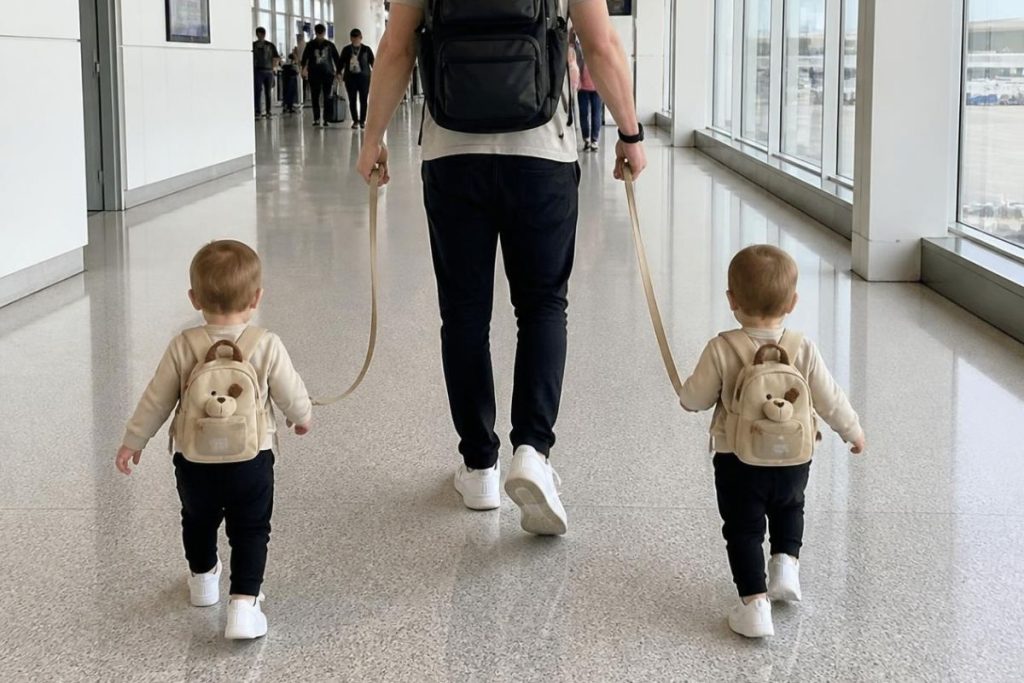
With toddlers, a wrist leash or a leash backpack can change the strategy. We used the Skip Hop harness backpack for exactly this: it lets a toddler walk on their own two feet through the terminal while keeping a free-roaming runner from getting away from you. That frees up a hand that would otherwise be holding a toddler instead of a bag.
With little kids, walking through the airport on their own is usually the easiest option, since most will listen and follow directions through security and the terminal. If the walk is long enough that little legs will need a break, one stroller can cover that without needing a full setup for both kids. Running two strollers still works too (think a trip to Disney) and one trick worth knowing: counter-check one stroller and gate-check the other, so a tired kid still has somewhere to sit near the gate even after the first one’s already checked.
| Age Stage | What Works Best | Why |
|---|---|---|
| Baby | A stroller, full stop | Can’t be set down without watchful eyes |
| Toddler | A leash backpack, plus any setup above | Frees a hand without losing a runner |
| Little Kid | Walking, with one stroller in reserve | Most will listen and follow directions |
Close Enough to Perfect
Quick version of the best stroller for flying with twins, now that the sections above have covered how each one works:
| Setup | Best For | Challenge |
|---|---|---|
| One Stroller | Fewer pieces of gear, the most nimble option through a busy airport | Someone’s always holding one twin, there’s no setting them down |
| Two Strollers | Flexibility, each adult manages one kid and one stroller | Twice the equipment to track, fold, and gate-check |
| Double Stroller | Simplicity, one unit instead of two | Wide and hard to maneuver, especially when changing floors |
| No Stroller | Traveling with three or more adults, or a destination that doesn’t need one | Someone’s always holding a baby, the whole way through |
So, What’s the Best Stroller for Flying With Twins?
One stroller: the lightest option, especially with something small enough to skip checking, like the gb Pockit. Works well solo or partnered.
Two strollers: the most flexible split between two adults, but the hardest to manage completely alone.
Double stroller: one unit to track instead of two, worth it for the car-seat snap-in, trickier everywhere else.
A fancy stroller: worth flying with only if your car seat snaps into it. Otherwise, it earns its keep at home.
No stroller at all: the simplest plan when someone else already has one waiting, or a destination doesn’t need one anyway.
Counter-checking what you brought: the right call for a stroller too big to gate-check, or one you’d prefer not to push through security at all.
Traveling solo: whichever setup above keeps a stroller in your hands longest, not whichever one is fanciest.
Traveling with a baby: a stroller isn’t optional, whichever kind you choose. With a toddler: a leash backpack does more for your hands than any stroller decision. With a little kid: let them walk, and keep one stroller in reserve.
None of these is the universal answer. All of them are the right one for somebody, for one specific trip. Your kids will grow, your destinations will change, and so will this answer. That’s fine. It’s supposed to.
Get the Twin Travel Survival Guide
Flying with twins for the first time? Get our complete packing checklist, airport survival strategies, and tested tips that actually work – free when you subscribe.
FAQ
No, in most cases. Most U.S. airlines check strollers free, the same as car seats, regardless of your baggage allowance. Confirm with your specific airline before you fly, since policies vary and change.
It depends on the airline. Some have no stated limit; others, like American Airlines in the past, have capped gate-check weight around 20 pounds, which pushes heavier double strollers toward counter-check instead. Check current policy directly with your airline.
Gate-checking means the stroller stays with you through security and gets tagged at the door of the plane, so you have it the entire way through the airport. Counter-checking means it’s checked at the ticket counter before security, and you don’t see it again until baggage claim.
No, on most U.S. carriers. A checked or gate-checked stroller travels in addition to your regular baggage allowance, not instead of it.
Lean toward whichever setup keeps a stroller in your hands the longest: a single stroller with the second twin worn or walking, or a double that’s gate-check friendly, not the fanciest one you own. Two separate strollers are the hardest setup to manage alone, since you’re pushing, folding, and reassembling two of everything with no second set of hands. See One Parent, Two Babies above for the full breakdown.
Only if it’s small enough to fit in the overhead bin, like the gb Pockit. Even then, it’s a single-seat solution, so twins still need a second plan for the other child.
There is a right option for your trip. It might be the Bugaboo staying in the closet at home, or it might be two cheap umbrella strollers that spend a night in a different closet than you meant them to. Either way, you’ll figure it out somewhere over an ocean, the same as the rest of us did.