
Stationed in Europe? The Smartest Way to Travel Europe on Military Orders
Europe • Military Stationed Abroad
August 4, 2026
Your sponsor apologized for the dog hair on the drive to TLF. He’d taken the family to France over the weekend, dog included, and hadn’t had time to clean the car. You had maybe four hours of sleep and still reeked of airplane cabin. Your first day stationed in Europe, and none of it felt real yet.
Somewhere on the highway he mentioned he had orders back to the States in June. “It’s been the best assignment of my career,” he said. He and his wife had a trip mapped out for every remaining long weekend. Then he asked: “What’s on your must-see list while you’re here?” You didn’t have an answer, but by the time you finish this post, You Will.

Your Must-See List Starts Here
Every destination in this guide, sorted by the season it’s worth visiting, mapped against the holidays you already have off. Print it, fill it, and watch your three years fill up. Join and get the Worksheet
What’s Inside This Guide
- Your 3-Year Clock Starts Now
- The 3-Hour Radius Rule
- Build a Travel Calendar Without Burning Leave
- How We Found £11 Flights
- Running the Numbers
- Europe as Your Gateway to the World
- Mistakes That Cost People This Assignment
- Your First 60 Days
- Frequently Asked Questions
Your 3-Year Clock Started the Day Your Orders Arrived
Congratulations on your government-sponsored European vacation. Kidding, kind of. Being stationed in Europe is still an assignment: a chain of command, a duty schedule, with deployments, and a leave balance with a hard ceiling. But it’s also a once-in-a-career window that closes the moment you PCS again (with or without warning). You can fill that window with dozens of visits to countries that once felt like faraway lands. Or you can spend three years waiting for the right time and PCS home with a list of places you meant to visit. The choice is yours, but the window for being stationed in Europe is just that, a window with an expiration date.
What Happens When You Wait
Ukraine was on the list. We kept pushing it to “later.” Four months after the last time we pushed it, it was off-limits. Morocco slipped through with policy changes. We went to Morocco, five years later from the States, and paid transatlantic fares that made us wince. And Ukraine? Still haven’t been.
The family who PCSes home with a drawer full of regrets didn’t run out of time. They waited for perfect timing that never arrived. The people who go everywhere understand this on day one: pick a destination, submit the travel request, sort the details after approval.
Quick Facts
Ukraine was on the list. Then, four months later, it wasn’t. The trips you keep pushing get crossed off one way or another. Book the ones that matter before circumstances make that decision for you.
Do This Before You Close This Tab
Most families arrive stationed in Europe and immediately get buried by in-processing. By the time they resurface, six weeks have passed and the first long weekend (or two) is already gone. Do these 3 things. Right now, before the next email arrives.
Find your base’s leave and travel policy. Ask your chain of command specifically: how far can you travel on a weekend pass, and how do they measure distance? (More on why that question matters in the next section.)
Mark every federal holiday and family day on your calendar. Open your phone. Do it now. These are your guaranteed travel windows. When command stacks a family day against a federal holiday, a two-day weekend becomes four. That’s a flight to Rome and back with time to spare.
Download the Military Trip Planning Worksheet. The worksheet has every step in this guide organized into a printable sequence, plus a destination wishlist template and a booking checklist.
Quick Facts
👉 The worksheet does this for you.
Your wishlist, your holiday calendar, and the booking sequence, all in one printable file.
Send Me the Worksheet
Print it, fill it, go.
The 3-Hour Radius Rule: What It Is and Why It Changes Everything
This one rule separates the families stationed in Europe who visit 5 countries from the ones who visit 25. But as you read on remember: EVERY base and EVERY commander has different policies. You must find out what the policy is for your base under your current commander.
What It Actually Means
Many bases allow personnel stationed in Europe to travel within a defined radius during a weekend or holiday pass without charging leave. You travel on Friday evening, explore all weekend, return by Monday morning, and your leave balance stays untouched.
The critical variable: how that radius gets measured.
How Your Base Measures It, and Why That Changes Everything
By car. Some bases define the 3-hour radius by driving time. From RAF Lakenheath in the UK, that covers London, Stonehenge, and the English coast. One country. Worth doing. But limited.
By train. Slightly more range: two or three countries. Amsterdam from Brussels. Zurich from Stuttgart. Better, but still contained.
By plane: this is where the assignment transforms. A 3-hour flight radius from most UK or German bases covers more than 20 countries. From RAF Lakenheath alone, a 3-hour direct flight reaches Paris, Rome, Barcelona, Oslo, Munich, Dublin, Edinburgh, Copenhagen, Vienna, Athens, Lisbon, and at least a dozen more. From Ramstein or Spangdahlem, the list extends further east: Warsaw, Budapest, Bucharest, Tallinn.
Twenty countries. Without touching your leave balance. That’s not an exaggeration.
| How the radius is measured | Countries reachable on a pass | Impact on your assignment |
|---|---|---|
| By car (3 hrs driving) | 1–3 | Still valuable, but limited range |
| By train (3 hrs rail) | 2–4 | More options in central Europe |
| By flight (3-hr direct flight) | 20+ | The entire continent opens up |
The Fine Print
Some bases measure door-to-door, not only flight time. If your base sits 90 minutes from the nearest airport, the flight runs 2 hours, and ground transport into the city takes another hour, the total clears 4.5 hours. You may need leave for that trip even if the flight itself qualifies. Ask how your specific base calculates the distance.
The rule can also change with the commander. What was permitted last year may not be permitted this year. Some destinations carry additional approval requirements regardless of distance: specific threat levels, political conditions, or country-specific clearances. Weekend travel sometimes operates under different rules than weekday travel to the same destination.
How to Get Your Policy in Writing
Go to your first sergeant or commander’s office and ask these specific questions:
- How is the radius measured: car, train, or flight time? Door-to-door or flight only?
- Does this policy apply to weekend and holiday pass travel only, or to weekdays as well?
- Which countries or cities require special approval regardless of distance?
- What does the travel request process look like, and how much lead time do you need?
Screenshot the email. Print the regulation. Save the PDF. You want documentation when you submit your first travel request, and you want it again when command changes and policies shift.
Quick Facts
The 3-hour radius rule varies by base and command.
Car, train, or flight? Door-to-door or flight time only? That single distinction determines whether you visit 5 countries or 25 during your assignment. Get your base’s policy in writing before you book anything.
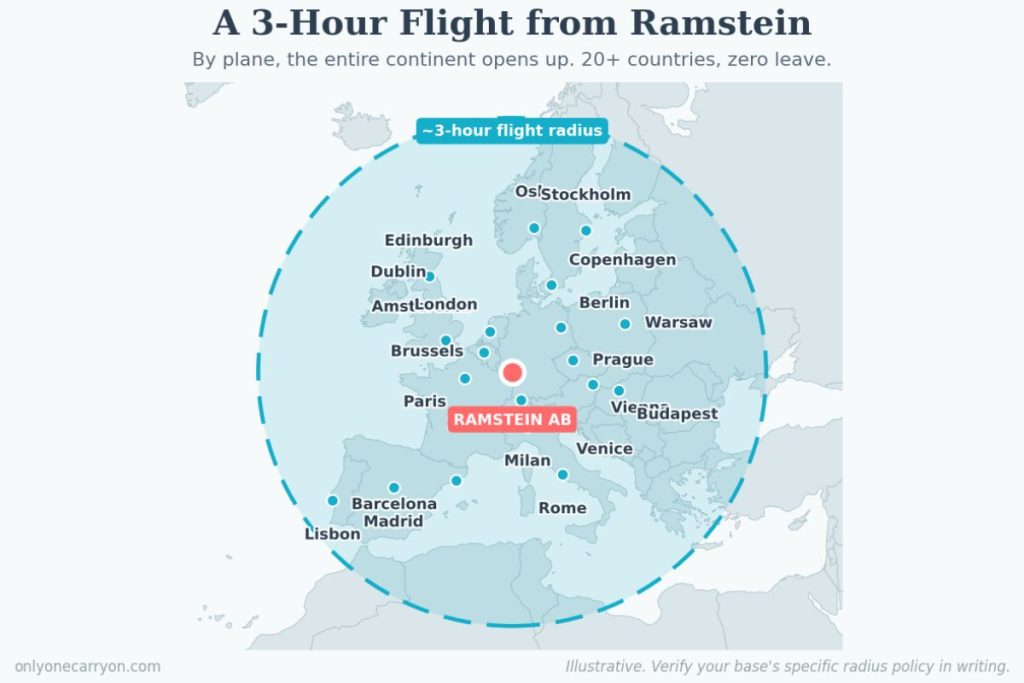
How to Build a Travel Calendar Without Burning Leave
Federal holidays are the backbone of no-leave travel when stationed in Europe. They don’t generally require leave, and (unless deployed) they’re predictable. When you treat them as travel windows from day one, twelve or more trips per year become possible. All before you’ve used a single day of leave.
Family days add another layer. Leadership sometimes announces additional days off (often around federal holidays) that can extend a three-day weekend to four or five days. The challenge: they don’t always get announced far in advance.
One of our favorite trips came together with ten days’ notice. A family day announcement dropped. Out of curiosity, we searched flights to “Everywhere” on Skyscanner. Cheap tickets to Latvia appeared, so we booked them. We booked a rental car and drove immediately into Lithuania. In Vilnius, complete strangers waved us in from the street to join a wedding dance. We never found out whose. Then: a lakeside eco-resort with kayaking, with a quick stop at Trakai Castle. On the drive back to Latvia, we passed farmers with horse-drawn plows while talking on mobile phones. Total planning time: a few hours spread over a week.
The lesson there wasn’t about Latvia. The lesson was what happens when you have a system in place: when a long weekend appears, you can move on it quickly.
Your Built-In Travel Windows
| Federal Holiday | When It Falls |
|---|---|
| New Year’s Day | January 1 |
| Martin Luther King Jr. Day | 3rd Monday in January |
| Presidents’ Day | 3rd Monday in February |
| Memorial Day | Last Monday in May |
| Juneteenth | June 19 |
| Independence Day | July 4 |
| Labor Day | 1st Monday in September |
| Columbus Day | 2nd Monday in October |
| Veterans Day | November 11 |
| Thanksgiving | 4th Thursday in November |
| Christmas Day | December 25 |
Plan Around the Season, Not Just the Holiday
Both winter and summer work when you’re stationed in Europe, but they serve different destinations. Mediterranean beaches and Greek islands peak in summer. The Northern Lights require the darkness of winter. Christmas markets exist only in December. Tulip season lands between March and May. Build your destination wishlist around when each place is worth visiting, then match those windows to your holiday calendar.

Save Your Leave for What Actually Matters
The pressure to use leave flying home for the holidays is real. We didn’t go back to the States (except TDYs) during our five consecutive years OCONUS. Instead, family and friends came to us. We became the reason people booked the trip they had delayed.
Was it hard? Sometimes. But every piece of leave we protected went toward what we wanted to see, but otherwise wouldn’t have been able to.
Three Weeks in Italy. One Last-Minute Phone Call.
The payoff was a three-week trip during year three: train and ship from the UK through Italy, the Adriatic, back through the Alps to Paris. One week out, Osteria Francescana (three Michelin stars, ranked the world’s best restaurant at the time) called with a last-minute cancellation in Modena. We rearranged two trains and one hotel to say yes.
None of it was possible without the leave we’d saved.

How We Found £11 Flights to Oslo (And How You Can Too)
One of the great advantages of being stationed in Europe is access to budget airlines that don’t exist at scale in the States. The first time we searched “Everywhere” on Skyscanner, flights to Oslo appeared for £11 per person. We booked before we had time to talk ourselves out of it. That Thanksgiving: Oslo, then Tromsø to chase the Northern Lights. Total flight cost to Norway? Less than one dinner out in London.
The “Everywhere” Search
Go to Skyscanner.com. Enter your departure airport and check nearby airports too, since a one-hour drive can reduce the ticket price by £100 or more. In the destination field, select “Everywhere.” You’ll see a ranked list of cities with current prices. Cross-reference that list against your destination wishlist and your upcoming holiday calendar. You’re not booking your dream destination. You’re booking the best overlap of price, timing, and your list.
Budget Airlines: What You’re Actually Paying
A £30 fare can become £90 before you finish the checkout process. Carry-on bag fees. Checked bag fees. Seat selection. Boarding pass reprinting if you forget to check in online. On one Barcelona trip, Ryanair charged us €55 each way for a single checked bag. That’s €110 total. More than both tickets combined. Read the baggage policy before you book, not after. Our full breakdown of what 52 real flights taught us is at the budget airlines guide here.
One winter we had Spain and Andorra planned on a budget carrier. The de-icing queue ran four hours. By the time we landed in Barcelona the rental car window was gone, Andorra was gone, and we had a great weekend anyway.
The lesson: budget airlines work well when you build flexibility into whatever comes after landing. Buy trip insurance. USAA offers cancel-for-any-reason travel insurance that covers the chaos. Never stack tight connections directly behind a budget flight. Have a Plan B before you book the Plan A. For delays that aren’t weather-related, EU261 may entitle you to up to €600 per person in compensation (this policy may change). AirHelp handles the claim process if you’d rather not deal with the airline paperwork yourself.
Trains: The Option Most Families Overlook
London to Paris on the Eurostar takes 2 hours 15 minutes, city center to city center. Factor in the airport check-in time, security, the flight, and the ground transfer into the city, and the train often beats flying even at a higher ticket price. Minimal baggage restrictions. No liquid rules. Walk on minutes before departure with a full-size water bottle and the jar of jam you bought at the market. For a packing list worth keeping, see The Best Way to Pack a Backpack for a 3-Day Weekend and 12 Unexpected Useful Things We Actually Pack on Every Trip.
Overnight trains deserve special attention. Book a sleeper car and you’ve covered both transport and accommodation in one booking. The Alps scrolling past at breakfast is worth the ticket alone.
For route research, Seat61.com covers every train journey in Europe with a level of detail no official rail site matches. Book tickets on Trainline or directly through the national rail operator once your route is confirmed.
Driving: When It Makes Sense
Road trips through Tuscany, the Scottish Highlands, or Provence require a car. The Chunnel is the straightforward option for moving between the UK and continental Europe: drive onto the train, sit for 35 minutes, drive off in France. Factor in off-base fuel costs on longer trips. European petrol prices run much higher than what you pay on base, and the difference adds up on a full tank.
Note: your gas card may only work at your home base. Don’t count on base fuel prices once you leave. Factor in local petrol costs for the full trip.
For car rentals, GetRentacar covers most European destinations with transparent pricing. For airport transfers when a rental doesn’t make sense, Kiwitaxi and Welcome Pickups are both worth comparing against local options.
Going to eastern Europe (or beyond) often creates a roaming problem worth solving before departure. AirAlo (150+ countries, no SIM swap needed) removes it.
The Booking Order That Protects Your Money
- Flights first. Prices rise as seats fill.
- Accommodations second. More flexible, often refundable.
- Activities last, unless the trip is built around something impossible to rebook. In that case, book that first. We’ve rearranged entire itineraries for a last-minute table. No regrets.

Running the Numbers Before You Fall in Love With a Destination
The pricing math cuts both ways: budget flights are real, but European city costs span a wide range. A £30 ticket to an expensive city can still blow the whole weekend budget.
Search for your actual party size. A hotel that shows €80 per night for two adults becomes a different number when you add children and need a suite or a second room. Search with your real headcount every time, or the price you see will bear no resemblance to the price you pay.
Check the local calendar before you book anything non-refundable. Museums across Europe close on Mondays or Tuesdays. Many restaurants in France close on Sunday and Monday. National holidays add closures that won’t show up on tourist maps. Friends of ours planned a Paris trip specifically around the Louvre: took leave, booked trains, built the entire itinerary around it. They arrived on a Tuesday. The Louvre is closed on Tuesdays. That full day, the one they’d saved for the museum, was gone. Check the opening schedule and closure days for every must-see attraction before you commit to anything non-refundable.
Munich hotels during Oktoberfest run €400 per night or higher. The same hotel in November costs around €90. If your goal is Oktoberfest, the premium is part of the experience. If your goal is Munich, go in November and put the savings toward another trip. Mediterranean destinations in August are hot, expensive, and crowded, and in many places locals take August off. Those same coastlines in May or September offer better prices, fewer tourists, and more comfortable temperatures.
Europe Is Also Your Gateway to the World
Being stationed in Europe changes what’s possible well beyond Europe. We went to South Africa, Sri Lanka, and the Maldives while stationed in Europe. All three would have cost more in both money and total travel time from any stateside base.
A direct flight from London to Johannesburg takes 11 hours and crosses barely one time zone. We slept on the plane, and when we landed we were ready to explore. From the US, that same trip adds at least a 6-hour time zone swing and often a connection, turning a single overnight into two full travel days before you’ve seen anything.
Before you start dreaming big: some exotic destinations have caveats. Some countries outside the Schengen zone require command clearance before you can even submit a leave request, and some have a minimum lead time between request and departure. Check with your command’s travel office early.
Hepatitis A and rabies require multiple injections weeks apart, so start the vaccine conversation with base medical before you find a good flight price. Malaria prevention means medication before, during, and after travel.

When Plans Change (Because They Will)
Military life is never steady, and being stationed in Europe is no different. TDYs, deployments, and family emergencies can all derail trip plans.
You can book many hotels at refundable rates for the same cost as (or a few dollars more than) the non-refundable rate. It’s almost always worth it. Rental cars are almost always the same price whether you pay now or later, especially when you book through a credit card travel portal.
Budget airlines require extra caution. They have no backup aircraft for weather delays. When a de-icing queue stretches four hours, you wait. Those delays can cascade into missed connections or activities. The Andorra trip we described earlier ended well specifically because we’d booked a refundable rental car and had no time-sensitive obligations at the other end.
This is why refundable reservations matter. When you lock flights early and immediately add non-refundable hotel reservations on the same day, a sudden TDY costs you twice. Another option: cancel-for-any-reason trip insurance from USAA. We’ve bought it. We know families who’ve used it. All of them said it was worth it.
The Calendar Format That Can Get You
European calendars start the week on Monday, not Sunday. When you book a reservation overseas and match dates by column position (the way you’d read a standard American calendar), you land on the wrong day. Spell out the full date: “Monday the 14th of October.” Not “October 14th.”
Before web browsers had translation extensions, we booked a dinner in Amsterdam for what we were certain was Sunday. It wasn’t. It was Monday. We found a good restaurant nearby, and eventually got back to that mis-booked reservation 18 months later. When in doubt, write it out and turn on language translation.
Quick Facts
Book refundable accommodations when flying budget airlines, especially in winter.
Don’t stack tight connections after a budget flight. Have a Plan B before you book Plan A. The families who travel without stress aren’t the ones with perfect trips. They’re the ones with flexible bookings.
Mistakes That Cost People This Assignment
The Six Mistakes Worth Knowing Before You Book
- Not submitting travel approval early enough. Travel approval isn’t a formality you fire off the day before departure. Some commands require a week’s notice. Others require thirty days. Certain destinations require additional clearance through channels that take time to move. We’ve watched it unfold as recently as a trip to Albania: the paperwork went in, but not early enough and not through the right process. Non-refundable flights. A lost trip. The rule is straightforward: get written approval before you book anything non-refundable, and build plenty of lead time into the request.
- Not checking closure days. Friends planned a Paris trip around the Louvre. They saved that museum for the middle day: rested, ready, prime time. It was Tuesday. The Louvre closes on Tuesdays. They spent the afternoon outside with expensive croissants and mild resentment. Check the opening schedule for every must-see attraction before you book anything you can’t change.
- Assuming the airport name matches the city. Frankfurt Hahn Airport is not in Frankfurt. It’s a 90-minute bus ride from the Frankfurt city center. Add €25 per person for the bus and three extra hours of travel on each end. Always verify the actual location of budget airline airports before you book.
- Underestimating how much small children need to move on long train rides. A five-hour scenic rail journey through the Alps sounds like a dream. Forty-seven minutes in with a two-year-old, the math changes. Shorter routes, overnight trains, or stopping halfway all work better when the youngest traveler measures time in snack intervals. See the Flying With Twins guide for 80-plus flights of experience, and 10 ways to keep a baby happy on a plane for the youngest travelers.
- Waiting to feel fully settled before booking the first trip. We took our first trip fifteen days after arriving in the UK. The household goods hadn’t arrived. But the trip happened, and every one after it got easier. The families who waited until they felt “fully settled” often found that fully settled never quite came. Year one disappeared. If you’re in your first ninety days in Europe right now, book something for next month before this tab closes.
- Assuming the bucket list destinations will still be available later. They won’t always be. Ukraine vanished from our list in four months. Don’t let the destinations that matter most stay on the wishlist too long. The window closes faster than it looks from the inside.
Your First 60 Days: What to Do Right Now
The first 60 days stationed in Europe set the pace for the entire three years. Book one trip.
Weeks 1–2: Research and Setup
- Download the Military Trip Planning Worksheet and fill it out
- Get your base’s 3-hour radius policy in writing (car, train, or flight? door-to-door or flight only?)
- Mark all federal holidays and known family days on your calendar
- List your top ten destinations and sort them: must-see, would-be-nice, bonus-if-it-works
- Download the Military Trip Planning Worksheet
Weeks 3–4: Start Price Checking
- Search “Everywhere” on Skyscanner for the next few federal holiday weekends, only to see what’s possible
- Check nearby airports as alternative departure points
- Browse Seat61.com for an overview of useful European train routes
- Sign up for Ryanair and EasyJet email alerts to catch flash sales
Weeks 5–6: Book the First Trip
- Pick one destination (not ten: one)
- Submit your travel request and get written approval
- Book flights the moment approval comes through
- Book accommodations within 24 hours, refundable where possible
Weeks 7–8: Finish the Planning
- Check opening hours and closure days for every must-see item
- Verify local calendar for holidays or festivals during your dates
- Download offline maps (Google Maps offline works well)
- Pack with your airline’s baggage policy in front of you, not from memory
Book Something in Your First 90 Days
This is how you go from meaning to, to booked. The destination wishlist, your holiday calendar, and the request checklist so nothing slips.
Your sponsor asked what was on your must-see list. Now you have one, and a system to work through it before your own orders come through.
Get your radius policy in writing, mark your holidays, pick the first destination, and submit the travel request before the week ends. The families who leave their stationed-in-Europe assignment with a passport that looks like a small novel all started where you are. First day in country. Dog hair on the seat. A question they couldn’t shake.
The window opened the day you landed. It’s still open.
Frequently Asked Questions
Many can, yes. If your base allows travel within a defined radius on a weekend or holiday pass, your leave balance stays untouched. The extent of what’s possible depends on how your command measures that radius. By direct flight, you can reach 20-plus countries without leave. By car, the range is far more limited. Get your base’s policy in writing before making any assumptions. The answer varies from one command to the next.
The 3-hour radius rule allows military personnel to travel within a defined distance during regular pass periods without charging leave to their balance. The rule varies by base and command: some measure the radius by driving time, others by train time, others by direct flight time. The measurement method determines whether your no-leave travel range covers two countries or twenty. Always verify your specific command’s policy and get it in writing.
Yes, for anything beyond your base’s allowable pass radius. Requirements vary: some commands need a full travel brief and itinerary, others only a written notification. Find out your specific process early and build it into every booking sequence. Book non-refundable flights only after written approval is in hand. Skip it and you lose money on non-refundable flights when approval doesn’t come through.
A three- to four-day trip for a family of four typically runs $400–$1,200 total (flights, accommodation, food, activities). Cost varies by destination, season, and how early you book. Budget airline tickets can run as low as $30–$50 per person when booked in the right window. Factor in baggage fees, which add up fast on low-cost carriers and can easily double the apparent ticket price. For real numbers, see our complete cost breakdowns: Rome, London, and Wales.
Focus on federal holidays and announced family days. Neither requires leave. Pair them with the 3-hour radius rule and you have travel windows available most months of the year. Stationed in Europe, we completed more than fifteen trips in a single year without using a single leave day. The strategy shifts toward closer destinations and shorter timeframes, but the trips still happen.
Related Posts
- Survive (and Win) Budget Airlines in Europe: Lessons From 52 Real Flights
- Rome in 24 Hours: How to See Absolutely Everything
- Flying With Twins: The Survival Guide That’ll Actually Save Your Sanity
- 48 Hours in London with Kids
This post contains affiliate links. If you book through them, we may earn a small commission at no additional cost to you. We only recommend tools and services we’ve used ourselves or that we’d confidently recommend to a friend.